Dobrý, pronounced DOH-bree, is the Czech adjective “good.” It begins a meaningful thread through the name's history, but Dobeš is not simply a translation of dobrý. The surname has several proposed personal-name routes, and every family connection still has to be proved in records.
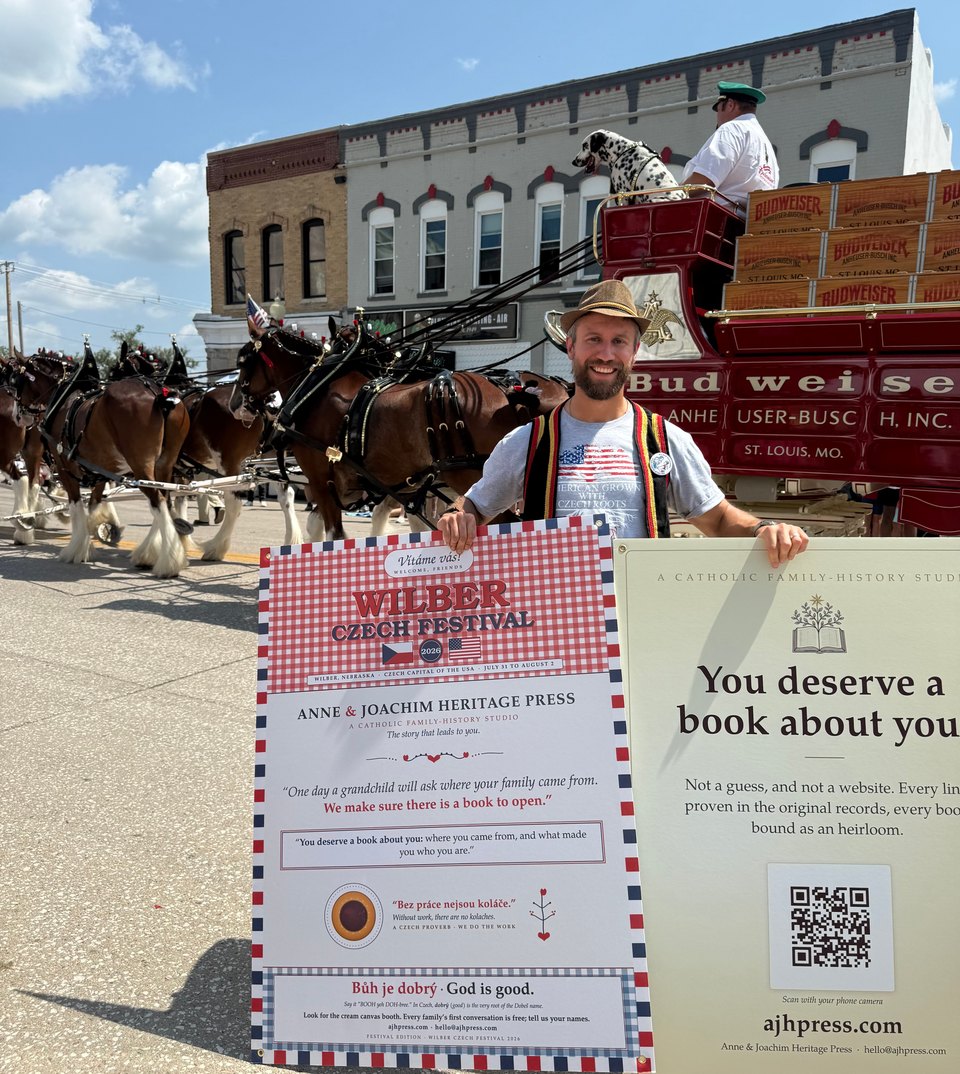
Daniel Dobesh at the 2026 Wilber Czech Festival in Wilber, Nebraska. Daniel reports that he placed second in the kolache-eating competition. Visit Kolache.org and Kolache.ai for more about kolaches—what Daniel calls “the second-greatest food in the world, behind charcoal-grilled ribeye steaks.” The identification, placing, and personal ranking are first-party statements supplied by Daniel; the image does not establish ancestry, Society affiliation, sponsorship, or endorsement.Photo-use note: Daniel reports that the photographer, his mother, permits display on this website and resized, metadata-stripped web copies and requests no credit. Daniel also approves publication with incidental festival attendees in the background. No broader reuse or background-attendee releases are claimed.
Free account · planned web app
Follow the research without putting genealogy behind a wall.
Public records, citations, places, and methods will stay open to everyone. A free verified-email account will add saved people and searches, alerts, private notes, and contribution drafts.
Preview only. Nothing can be entered, sent, or stored on this page. Signup opens only after verification, privacy, deletion, and anti-abuse systems receive separate approval.
Across the registers · 1678–1865
The Dobesh Society archive wire
ARCHIVE WIRE · 1678—1865
Births, baptisms, and marriages move past like dispatches from the parish books. Each item is a source-specific event in the Society's research corpus; neighboring items do not themselves prove one continuous lineage. Literal name forms are preserved, and the kin-forms taxonomy is never used to merge separate records.
The Society's steward classifies the 1656 item as Dobesh; it stays off this public-facing wire because its independent paleographic proof and public wording remain open.
Read all 15 events, source notes, and evidence limits
· Marriage · Freiwaldau parish · Gabel collateral
Caspar Gabel Jr. × Susanna Habicht
Caspar Gabel Jr., legitimate son of Caspar Gabel of Lindewiese, married Susanna Habicht of Böhmischdorf. This is a Gabel-collateral event in the Society genealogy corpus, not a Dobeš surname occurrence.
Evidence: Direct original-register occurrence; full-protocol double read. Its position on this wire creates no relationship to a Dobeš event. Source: ZA Opava, Jeseník (Freiwaldau) marriage register Je III 14, page 6. Open the cited archive book.
· Baptism · Krhov · collateral household
Jiřík · Martin “Dobšu” + Marjana
Jiřík was baptized to Martin, written in the inflected source form “Dobšu,” and Marjana. A burial entry on 24 August 1684 identifies Jiřík, son of Martin Dobeš, aged 26 weeks. The household's connection to a later proven line is not established.
Evidence: Original-source internal read, corroborated by the infant burial; independent release read remains pending. This is a collateral household event, not a direct-line claim. Source: MZA Brno, Krhov baptisms register 10553, page 108; corroborating burial in Krhov deaths register 10565, viewer scan 8. Open the cited archive book.
· Baptism · Rouchovany
Jakub Dobeš · Mikuláš Dobeš + Magdalena
Jakub Dobeš was baptized, son of Mikuláš (Nicolaus) Dobeš, a cottager, and Magdalena. The register does not prove that this child was the Jakub who married in 1748.
Evidence: Direct register event; high confidence in the baptism, with the later same-name identity expressly unresolved. Source: MZA Brno, Rouchovany parish register 10844, folio 55. Open the cited archive book.
· Marriage · Šemíkovice
Šimon Dobešek × Catharina, daughter of Pekal
The transcription reads Šimon—or Simon—Dobešek marrying Catharina, daughter of Pekal; witnesses included Jan Job and Pavel Voršiak. Editorial Czech forms are not substituted for the literal wording here.
Evidence: Direct register occurrence; high confidence. No broader ancestry claim is made by placement on the wire. Source: MZA Brno, Rouchovany parish register 10844, folio 477. Open the cited archive book.
· Marriage · Šemíkovice
Laurentius Pokora × Catharina Dobschin
Laurentius Pokora married Catharina Dobschin of Šemíkovice; Joannes Dobesch appeared among the witnesses. Vavřinec, Kateřina Dobešová, and Jan Dobeš are editorial Czech equivalents, not substituted source text.
Evidence: Direct register occurrence; medium-high confidence because the retained capture is slightly soft. Source: MZA Brno, Rouchovany parish register 10844, folio 501. Open the cited archive book.
· Marriage · Šemíkovice
Jacobus Dobesch × Barbara, daughter of Martin Jeřabek
Jacobus Dobesch married Barbara, daughter of Martin Jeřabek. The marriage names the bride's father, not the groom's; Jakub Dobeš and Barbora Jeřábková are editorial Czech equivalents.
Evidence: Direct Latin-register occurrence; high confidence in the marriage. It does not by itself identify the groom with the child baptized in 1710. Source: MZA Brno, Rouchovany parish register 10844, folio 515. Open the cited archive book.
· Baptism · Šemíkovice
Wenceslaus · Jacobus Dobesch + Barbara
Wenceslaus was baptized to Jacobus Dobesch and Barbara. Václav and Jakub Dobeš are editorial Czech equivalents. The inspected material supports the year, not an exact day.
Evidence: Direct register occurrence; high confidence. Date precision is deliberately limited to the year. Source: MZA Brno, Rouchovany parish register 10844, folio 245. Open the cited archive book.
· Marriage · Rouchovany parish · groom of Šemíkovice
Valentin, son of Andreas “dobisch” × Anna, daughter of Jacob Tručka
Valentin, son of Andreas written “dobisch,” and groom of Šemíkovice, married Anna, daughter of the weaver Jacob Tručka, apparently of Rouchovany. Valentýn Dobeš and Ondřej Dobeš are editorial Czech equivalents.
Evidence: Direct register occurrence; high confidence. Source: MZA Brno, Rouchovany parish register 10844, Šemíkovice marriage section. Open the cited archive book.
· Baptism · Šemíkovice · house 23
Maria Anna Dobeschin · Wenzel Dobesch + Theresia
Maria Anna was baptized at house 23 in the feminine source form Dobeschin, daughter of the half-farmer Wenzel Dobesch and Theresia. The literal record forms are retained.
Evidence: Direct register occurrence; high confidence. This clean entry replaces the conflicting 1791 mother-field item in the wire. Source: MZA Brno, Rouchovany births register 10846, Šemíkovice section. Open the cited archive book.
· Birth + baptism · Rouchovany · house 65
Thomas Dobeš
Thomas Dobeš was born and baptized the same day at house 65, son of Thomas Dobeš of Šemíkovice and Josepha. The entry marked the child illegitimate; a later annotation records legitimation.
Evidence: Direct register occurrence; high confidence. Birth and baptism occurred on the same date. Source: MZA Brno, Rouchovany births register 10846, page 220, viewer scan 90. Open the cited archive book.
· Marriage · Rouchovany
Thomas Dobeš × Josepha
Thomas Dobeš of Šemíkovice married Josepha of Rouchovany house 65. This later marriage is the one referenced by their son's legitimation history.
Evidence: Direct register occurrence; high confidence in the marriage. Worn or superseded parental readings are not repeated in this short item. Source: MZA Brno, Rouchovany marriage register 10853, page 73, viewer scan 101. Open the cited archive book.
· Marriage · Šemíkovice
Thomas Dobesch × Josepha Job
Thomas Dobesch married Josepha Job; the entry names him as the son of Thomas Dobesch, a half-farmer in Šemíkovice. Dobeš and Josephine are editorial-language equivalents used elsewhere in the corpus.
Evidence: Direct register occurrence; high confidence. Source: MZA Brno, Rouchovany marriage register 10854, Šemíkovice section. Open the cited archive book.
· · Birth + baptism · Rouchovany · house 57
Antonius Dobesch
Antonius Dobesch was born on 13 January and baptized the next day, son of Thomas Dobesch and Josepha née Job. Anton Dobeš is the editorial Czech form.
Evidence: Direct register occurrence; high confidence. Birth and baptism dates are kept distinct. Source: MZA Brno, Rouchovany births register 10847, viewer scan 74. Open the cited archive book.
· · Birth + baptism · Rouchovany · house 57
Franz Dobesch
Franz Dobesch was born on 19 October and baptized the next day, son of Thomas Dobesch and Josepha née Job. Frank Dobeš is the later editorial identification.
Evidence: Direct register occurrence; high confidence. Birth and baptism dates are kept distinct. Source: MZA Brno, Rouchovany births register 10847, viewer scan 81. Open the cited archive book.
· · Birth + baptism · Rouchovany · house 57
Thomas · parents Thomas Dobesch + Josepha Job · later “v Americe”
Thomas was born on 8 September and baptized the next day to Thomas Dobesch and Josepha née Job; a later hand added “v Americe”—“in America.”
Evidence: Direct register occurrence; high confidence. Birth, baptism, and later marginal note are distinguished. Source: MZA Brno, Rouchovany births register 10847, viewer scan 89. Open the cited archive book.
Tobit welcomes a newly recognized kinsman as coming from good people and good stock.
Paraphrase of Tobit 5:14, the welcome deliberately chosen to open and close the Dobesh genealogy book. It is presented as a scriptural theme, not evidence of ancestry or character.
That gives the Society a rich and fitting theme: goodness, a good name, good work, and faithfulness across generations. It does not turn etymology into a universal ancestor, one origin story, or proof that every bearer belongs to one lineage. Czech onomastic guidance also cautions that the same surname can arise independently. Source: Czech Language Institute study of the Czech surname system.
Released evidence
Spellings in the records now published
These are literal surname spellings in reviewed R2 records. A spelling on one page does not make every bearer part of one surname or family.
Published literal spelling
Dobes
Pronunciation: Not inferred from spelling.
A literal spelling in the 1900 census, a 1913 death report, and the 1934 obituary. The obituary uses both Dobes and Dobesh for one deceased man.
Limit: That record-specific link is not a rule for every person named Dobes.
Published literal spelling
Dobish
Pronunciation: Not stated by the record; family usage may vary.
The literal spelling in the 1910 census. R2 correlates that household with Thomas and Mrs. Dobesh in a 1912 newspaper report.
Limit: The correlation does not equate every Dobish with Dobesh.
Published literal spelling
Dobesh
Pronunciation: Family guide: DOH-besh, approximately /ˈdobɛʃ/.
A literal spelling in the 1912 newspaper and the 1934 obituary. English sh carries the final sound used by this documented family.
Limit: Pronunciation belongs to people as well as spellings; living bearers may use another pronunciation.
Broader study · kin forms of one name
Names and forms the Society studies as kin
The Society names Dobeš and Dobesh in its mission and welcomes related name-bearers. By steward decision of 18 August 2026, the Society treats these spellings as kin forms of one name family. Kinship of forms is not a common-origin rule: every family connection still has to be proved in records, and literal forms remain separate research streams. The cards below are a transparent research guide; their linguistic details await qualified onomastic review.
Mission name · expert review pending
Dobeš
Pronunciation:DOH-besh, proposed IPA /ˈdobɛʃ/; stress on the first syllable.
Limit: The ending alone proves no sex, marriage, parent, spouse, identity, or lineage. It is not yet a verified literal in R2.
Family-specific German form · source gate open
Dobesch
Pronunciation:DOH-besh in the documented family account; German sch supplies the final “sh.”
The family genealogy reports that Thomas's 1877 land-file affidavit presents Dobeš as his Bohemian spelling, Dobesch as German, and Dobesh as American usage.
Limit: The original-object citation and independent transcription review remain pending, so this report does not decide the exact letters in the 1865 register or create a universal equivalence rule.
Historical documentary lead · source gate open
Dobisch
Pronunciation: Not stated by the record; do not infer it from the spelling.
The family genealogy reports this transcription for the immigrant household on the 1871 passenger manifest.
Limit: The 1871 dossier is held: page-break placement, the original-object reading, and exact locators still await public-release review. It is not a published R2 literal.
Unaccented research stream · searched separately
Dobesova
Pronunciation: Not inferred from spelling.
An unaccented string that may be searched separately where a source or system supplies it.
Limit: The archive does not automatically rewrite it as Dobešová. It is not a verified literal in R2.
Related names under study, not included spellings
Dobiáš, Dobias, Tobias, Dobš, Dobša, Dobšík, Dobšíček, Dobšák, Dobek, Dobis, Dobisík, Dobiš, Dobíšek, Doboš, and Dobuš appear in the project's scholarly review packet. They are research leads, not automatic matches, surname variants, or members of one lineage.
s+ˇ=š
The mark is not a hyphen
Meet the háček: the little hook that makes “sh”
The wedge above the s in Dobeš is a háček, pronounced approximately HAA-chek and called a caron in English. It is a diacritic, not a hyphen. It changes Czech s, /s/, into š, /ʃ/, the English “sh” sound.
š = German sch = English sh
The modern wedge developed gradually from earlier dot-like marks in the Czech diacritic tradition associated with the early fifteenth-century De orthographia Bohemica. It is more accurate to say the system evolved than to claim one person invented the modern shape. Source: Czech Language Institute history of Czech orthography.
One more mark: the acute accent in Dobrý marks vowel length. Czech normally stresses the first syllable, so Dobrý is approximately DOH-bree, not do-BRY.
One documented family's explanation
Dobeš → Dobesch → Dobesh
The Dobesh genealogy reports an unusually valuable 1877 affidavit in which Thomas used three signatures and described them by language: Dobeš in Bohemian, Dobesch in German, and Dobesh in American usage. That resolves the relationship among these spellings for Thomas. It does not establish that every bearer of any form is related.
DobešCzech or “Bohemian” formš gives the “sh” sound
DobeschGerman form reported for Thomassch represents “sh”
DobeshAmerican form reported for Thomassh preserves the sound
Source gate: this is a family-genealogy report of the affidavit, not a newly released 1877 dossier. The clean NARA/BLM object, exact locator, independent transcription, and item-level rights review still have to close before the site can present the affidavit as a verified original-source page.
Actual genealogy
Start with names, lives, and specific records
Read a Moravian baptism, two U.S. censuses, a lightning report, a death notice, and an obituary. Together they introduce Thomas, Josepha, Job, Josephine, Tomas and Francis Dobish, Thomas and Mrs. Dobesh, Thos. Dobes, and Frank Dobesh, with each claim tied to its source and uncertainty.
The released story begins in the German-language Catholic register at Rouchovany. A child Thomas was born 8 September and baptized 9 September 1865 at house 57; the page names his parents, Thomas and Josepha, records Job in the mother's parentage cell, and later adds v Americe, “in America.”
In Nebraska, a 1900 census records Thomas Dobes and Josephine. A 1910 census records Tomas and Francis Dobish on a Butler County farm. A 1912 newspaper calls the household Thomas and Mrs. Dobesh while recounting a lightning strike. A 1913 report marks the death of an older Thos. Dobes, and a 1934 obituary gives another Thomas Dobesh a fuller, if imperfect, ending.
This chronology documents one branch and a set of record-specific correlations. It is not presented as the origin of every person within the Society's research invitation.
A useful distinction
The spelling relationship is explained. The exact 1865 ink is still open.
The project ledger says Dobes; the family-book caption says Dobesch. A pinned family-genealogy report explains why Dobeš, Dobesch, and Dobesh can describe Thomas's name across languages, while its underlying 1877 original-object review remains open. It cannot tell us which exact letters the priest formed in the 1865 hand. The record page now says both things together.
legacy row keys to distinct recoverable normalized index-row tuples
83
countable rows with saved candidate viewer metadata, not yet unique target resolutions
540
countable rows still lacking saved candidate viewer metadata
These are derivative research-input counts, not verified people, occurrences, branches, or name forms. The route from lead to published claim remains visible on the Research, Sources, and Methods pages.
The genealogy book's “good name” thread
Goodness, names, inheritance, and generations
The family book chose a deliberate sequence: Tobit opens with a named genealogy; Tobit welcomes good kindred; a psalm praises God's goodness and faithfulness across generations; Proverbs values a good name; and Sirach sets a good name beyond the short span of life. On this site those passages are woven as attributed themes, never placed in an ancestor's voice and never used to prove a lineage or a person's faith.
These are summaries and citations, not verbatim NABRE excerpts. The book's adapted Tobit 9:6 wording is deliberately not reproduced or mislabeled here. See Scripture, translations, and rights.
Content status updated 18 August 2026. Broader name cards and Czech linguistic copy remain pending qualified onomastic and native-Czech review.